
Home-Start Lambeth – Pilot Report (2025–26)
Introduction
Home-Start Lambeth supports families with young children through relationship-based, volunteer-led parenting support. We support families to develop resources, support and confidence so that they can provide their children with positive early years experiences. When parents and carers (hereafter referred to as parents) are more connected and supported, they can overcome challenges and their children are more likely to thrive.
In 2025–26, we partnered with Home-Start Hillingdon to pilot a new child outcomes measurement tool designed to capture, more directly, the difference our support makes for children. The partnership brought together Home-Start Lambeth’s strengths in data capture, analysis and evidence building with Home-Start Hillingdon’s expertise in developing reflective, child-centred practice.
This report shares what we have learned from this initial pilot locally, how our support contributes to early childhood development, and how we plan to build on this work in the future.
Our approach: measuring what matters for children
Building on the expertise developed through Home-Start Hillingdon’s reflective, child-centred tool (PLANTS), we designed a practical outcomes framework aligned with the Common Outcomes Framework ensuring consistency with sector practice.
The tool assesses children’s experiences across five key domains of development:
- Safe
- Healthy
- Happy/Positive relationships
- Learning & Play
- Engaged
And the model reflects well-established evidence on supporting early childhood development, including:
- Attachment theory – developing and strengthening secure relationships
- Serve and return interaction – supporting communication and cognition
- Play-based learning – enabling development through play
- Community connection – reducing isolation and building support networks.
The framework focuses on observable behaviours and everyday experiences, making it meaningful for both families and practitioners. These domains are assessed at the start and end of our support, enabling us to track change over time and understand the impact of our work.
Home-Start Hillingdon provided the initial framing and design of this tool. At Home-Start Lambeth we built on our experience of implementing evidence frameworks, following our implementation of the Warwick Edinburgh Wellbeing Scale (work funded by Lambeth Mental Health Inequalities Fund). We strengthened the tool to enable more consistent data collection and improved comparison across cohorts. This collaboration has resulted in a robust and practical approach to our work with families. Together with Home-Start Hillingdon we have combined strong practice knowledge with systematic ways of capturing and analysing service outcomes.
This pilot will be followed up with benchmarking of scoring between Home-Starts Hillingdon and Lambeth as a next step.
Who we worked with
Our study looked at families who had received our support in the last 12 months. These families frequently faced multiple and overlapping challenges, including poverty, isolation and poor mental health.
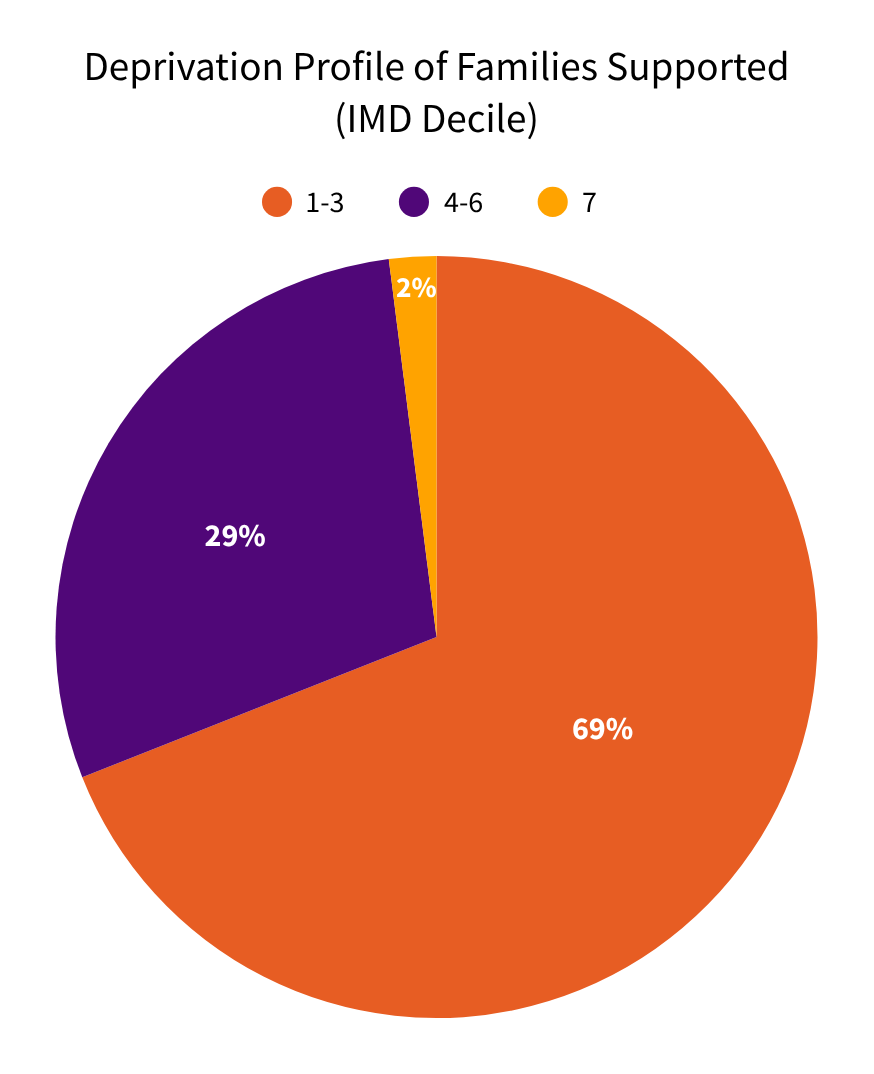
Deprivation profile (IMD)
- 69% of families supported live in the most deprived areas (IMD 1-3)
- 29% in IMD 4-6
- 4% in IMD 7
- No families in IMD higher than 7
The families we support live in more deprived areas than the average Lambeth resident. Lambeth’s local authority deprivation decile is 4. The families included in this study had an average deprivation decile of 3.4.
Families supported by Home-Start Lambeth live in neighbourhoods that are in the lower third nationally. Nearly 7 in 10 families we support live in the most deprived third of neighbourhoods in England and almost all (98%) families are in the bottom half of deprivation nationally.
Ethnicity Profile
The families supported reflect the diversity of our communities, including:
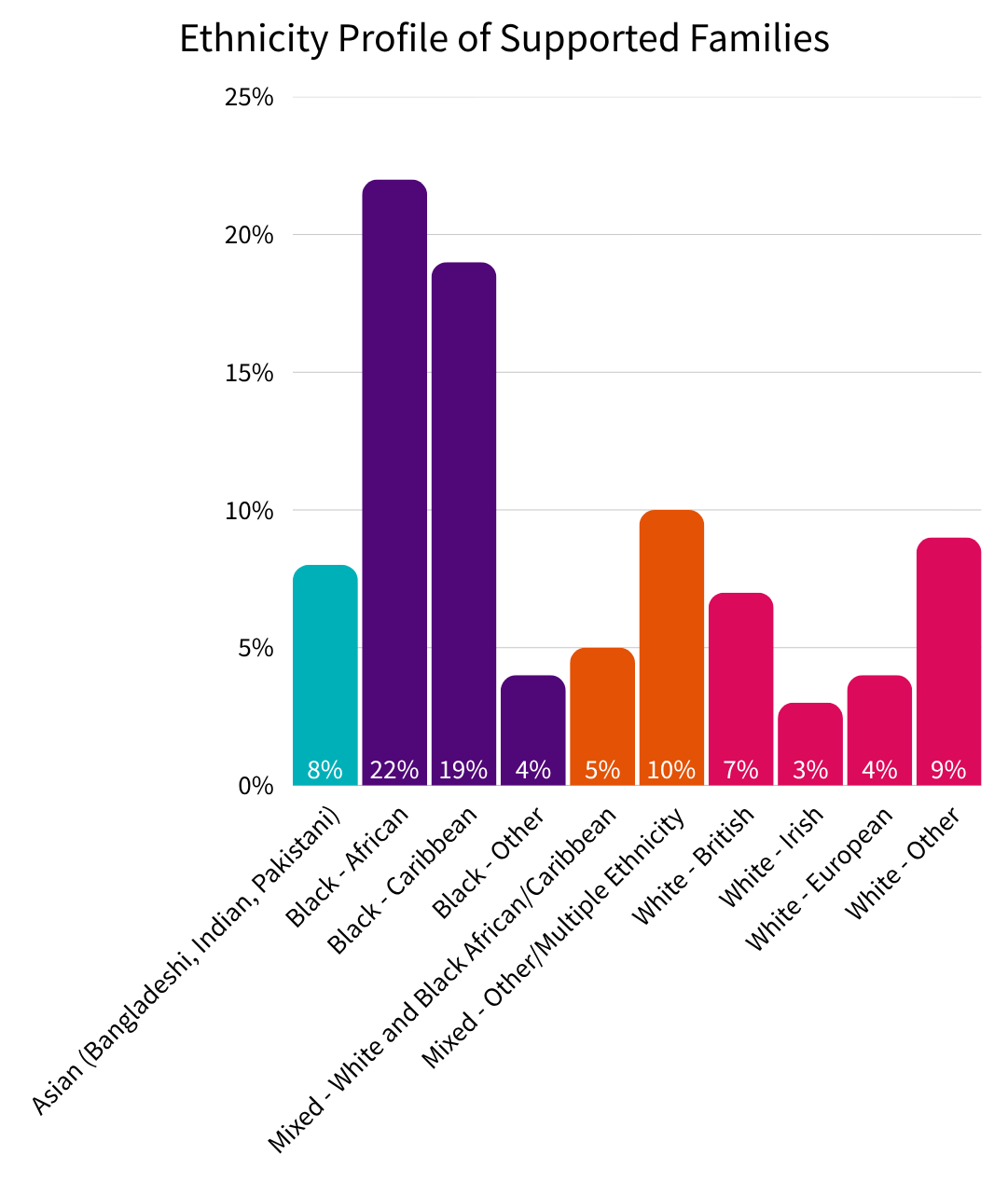
Ethnic diversity in Lambeth
Lambeth is an ethnically diverse borough. According to the 2021 Census, 55.0% of Lambeth residents identified as “White”, 24.0% as “Black, Black British, Caribbean or African”, and 8.1% as “Mixed or Multiple” ethnicity (Office for National Statistics, 2022). Interestingly, the latest projections estimate that only 38% of Lambeth residents are White British, compared with 80% across England (Lambeth Council, 2022).
The families HS Lambeth support are more often among Black ethnicity groups (around 50%) and less likely to be White (around 25%) than Lambeth’s overall population.
What difference did we make?
Across Home-Start Lambeth’s pilot, we saw clear and meaningful improvements in children’s development over the course of their programme of support:
- The average child outcome score increased from 89 to 108
- This represents an overall improvement of 22%
Notably, progress was not limited to a single area. We saw consistent improvement across all five domains of development, indicating broad, whole-child impact.
Alongside our longstanding evidence that parents feel more confident and better able to cope following our support, these findings show how changes for parents translate into positive outcomes for children. When parents feel supported, children benefit across multiple aspects of their development.
These findings suggest that our relationship-based model helps create the conditions in which children can thrive, feeling safer and healthier, building positive relationships, and becoming more confident in their learning, play and engagement with the world around them.
Where we make the biggest difference

The largest improvements were in:
- Engaged (+63%)
- Learning (+29%)
These areas reflect the most important shifts we noted in our practice observations, children becoming more connected to the world around them and more actively involved in everyday play and learning.
This progress is closely linked to the goals families set for themselves when they start being supported by us. Parents frequently describe themselves as very isolated and overwhelmed. At the end of our support, we see important changes in their children’s lives, including:
- increased opportunities for children to socialise and explore
- stronger connections with local services and community activities
- more frequent and positive interactions between parents and children
Our support is helping children to engage, learn and build relationships more confidently.
Understanding outcomes across different families
One of the strengths of this pilot is the ability to explore how outcomes vary across different groups.
We found that some family circumstances resulted in variations in our child outcomes data:
Disability
- Where parents have disabilities (46% of families in the dataset), whether physical or learning disabilities, on average their children start their support with lower scores when compared with other children. Following Home-Start support, this gap reduces. However, the biggest variation they experience is in the safety of their home environment, and this remains true at the end of our support.
- These children are more likely to live in unsuitable housing: 65% vs 50% of the families we support without a disabled parent.
- Children with disabilities (58% of families in the dataset) also start support with higher needs, but this gap closes, bringing their scores more in line with children without disabilities at the end of our support.
Parental mental health and domestic abuse
- Where parents are struggling to manage their own mental health (62% of parents in the dataset), our initial data showed an impact on their children’s scores. We saw similar challenges for survivors of domestic abuse (31% of parents in the dataset). These children start and end their support with slightly lower scores than their peers. We understand the strains on these families, they are more likely to be on a low income and live in unsuitable housing. Despite this their children had made significant progress with our support. These areas require further study and attention, and we will monitor this as our dataset develops.
Immigration status
- Children who are asylum seekers and refugees have the largest variation in the Engaged category (7% of families in the dataset). They started with lower scores and showed the biggest improvement. Our service helps newly arrived children feel secure, valued and integrated into their local community.
We are so pleased to see the huge benefits of our service across families affected by the above challenges. The fortitude and determination of their parents underpins the achievements our service has been able to support families to achieve. Our observations across all the circumstances listed above are early observations and there is variation within our dataset. This is not true for all families and not true for all children. We will be studying this and building our evidence base over time.
Ethnicity, IMD and outcomes
Children from all ethnic groups experienced positive change over the course of support.
Similarly, end scores across all IMD are within 3 percentage points of one another.
Across the dataset, improvements were consistently seen in the following domains:
- relationships
- learning and play
- social engagement.
This indicates that the model of support is effective across a diverse range of families, with children benefiting regardless of their ethnic backgrounds or IMD.
Our tailored approach, combined with our ethnically and culturally diverse volunteer base, enables us to respond flexibly to individual family needs. As we continue to build the dataset, we will be able to explore outcomes in more depth, ensuring that our impact is consistent across groups and adapting our approach where needed.
A service for the whole journey
Taken together, this pilot evaluation evidences that Home-Start Lambeth’s model of support is not just effective in improving parents’ ability to cope but is also impactful for children across a range of starting points:
- Supporting families in crisis to stabilise and improve
- Helping families with moderate needs to make meaningful progress
- Enabling stronger-starting families to further enrich their children’s development.
This breadth of impact reflects a model that is both targeted and preventative, supporting children not only to overcome early challenges, but to thrive.
Conclusion: building the evidence for early support
This pilot provides clear and consistent evidence that relationship-based parenting support can make a meaningful difference to young children’s development. Across the cohort, children showed measurable progress over time, with improvements seen across all five areas of development. These findings strengthen the link between supporting parents and improving outcomes for children.
We have also found a particular strength for our service: supporting children to explore, socialise and interact with their community and developing the home learning environment in ways that stimulate early brain development and support pro-social development and communication.
The data also highlights the importance of reaching families at the right time. Many children began support from a lower baseline, particularly those living in more deprived areas. The stronger gains seen in these groups suggest that early, targeted support can help narrow gaps in development, enabling children to make progress from where they start. At the same time, improvements across all groups demonstrate that the model adds value across a wide range of family circumstances.
This pilot has shown that it is possible to measure our service through a child-focused lens in a way that is both practical and meaningful. By combining reflective practice with systematic data collection, this new tool provides a clearer picture of change over time and supports a more evidence-informed assessment of our service delivery.
As this work develops, there is further opportunity to build on these insights. A larger dataset will allow for deeper analysis of outcomes across different groups, strengthening understanding of where impact is greatest and ensuring it is consistent across communities. There is also potential to use this learning to inform service design, strengthen delivery and support continuous improvement.
Taken together, the findings point to a model that is both responsive and preventative, supporting families facing significant challenges while also helping others build on existing strengths. In doing so, it contributes to a stronger foundation for children’s early development and a clearer evidence base for the role of Home-Start Lambeth’s early support in improving outcomes.
Next Steps
Data consolidation and benchmarking
The pilot has established a strong foundation for measuring child outcomes in a practical and meaningful way. The next phase will focus on consolidating this data to improve consistency, reliability and comparability over time.
As the dataset grows, there will be greater opportunity to benchmark results across Lambeth and Hillingdon, with the ambition to share our model widely across other Home-Start services. This will enable a clearer understanding of service nuances, where impact is strongest, and how outcomes vary across different contexts
Benchmarking will also support ongoing learning by helping to identify patterns, strengthen confidence in the findings, and inform service development. Over time, this will contribute to a more robust evidence base for the role of relationship-based support in improving early childhood outcomes.
Partnership working
Our new tool is designed to measure change in children’s developmental experience over time, with a particular focus on early childhood development (EDC). It aligns with the emerging national Common Outcomes Framework (COF) (Common Outcomes for Children and Young People Collaborative, n.d.), and Elaine Fulton has confirmed that it is broadly consistent with this approach. This means that findings from our pilot can sit alongside wider sector evidence and be compared with national practice.
As our partnership with the Collaborative continues, we are exploring how to strengthen this alignment further, particularly in relation to the London co-produced Family Hubs and Beyond framework, while ensuring the tool remains practical and grounded in the realities of our local community.
Introducing parent and child voice
A key next step is to strengthen how the voice of the child is understood and reflected through our direct work with parents. This is important for improving practice and ensuring that the assessment of children’s development is transparent, inclusive and grounded in families’ lived experience.
Rather than adding further questions to the current assessment process, this work has created an opportunity to review the process more fundamentally. The existing assessment has remained largely unchanged for more than 15 years, and there is clear potential to make it more focused, accessible and aligned with outcomes for children: a current gap.
Home-Start UK is currently reviewing the assessment process at a national level, creating an opportunity to test and shape new approaches locally. As part of this, a revised set of questions will be piloted, with learning contributing to wider development across the network.
Working in partnership with Home-Start Hillingdon, our assessment processes are being redesigned to better align with the outcomes framework and to support more meaningful engagement with families.
The revised approach will:
- replace the current assessment with a shorter, more focused set of questions
- integrate the parent voice, the voice of the child and goal-setting within a single process
- support families to reflect on their starting point and track progress over time
- provide a clearer and more consistent basis for capturing child development information
This represents an important shift in how we work with families: moving towards a more structured and meaningful understanding of children’s everyday experiences. Embedding the voice of the child within practice strengthens not only the quality of support, but its focus and intent.
Through this work, children’s voices and experiences will increasingly shape both the support offered to individual families and the development of services as a whole, ensuring that everything we do is grounded in what matters most to children.
Footnotes
Office for National Statistics. (2022, November 29). Ethnic group, England and Wales: Census 2021. https://www.ons.gov.uk/peoplepopulationandcommunity/culturalidentity/ethnicity/bulletins/ethnicgroupenglandandwales/census2021
Lambeth Council. (2022, August 19). Health profile for Lambeth 2022: Section 1 – Demography (Version 1.1). https://www.lambeth.gov.uk/sites/default/files/2022-10/health-profile-for-lambeth-2022-section-1.pdf
Common Outcomes for Children and Young People Collaborative. (n.d.). Common Outcomes for Children and Young People Collaborative. Retrieved July 1, 2026, from https://www.commonoutcomes.org.uk/